









Selecting the correct viscometer serves as the foundation for reliable product quality and consistency in any manufacturing environment.
Many laboratory professionals encounter frustration when their expensive equipment provides fluctuating data on seemingly simple samples. This issue often stems from a mismatch between the instrument type and the fluid’s physical behavior.
You must understand the specific flow characteristics of your material before investing in new technology. This guide assists you in navigating the complex landscape of fluid testing to find the perfect solution for your lab.
The Science of Flow: Understanding Fluid Behavior
The first step in choosing an instrument involves classifying the material you intend to test. Viscosity represents a fluid’s resistance to flow, but this resistance does not always remain constant. We categorize fluids into two primary groups based on how they react to applied force.
Newtonian Fluids
Newtonian fluids possess a stable viscosity that does not change regardless of how fast you stir or pump them. Water, simple solvents, and thin motor oils fit into this category perfectly. You can measure these materials using a single speed or pressure point because the value remains linear. A simple test method yields accurate results for these predictable liquids.
Non-Newtonian Fluids
Non-Newtonian fluids display complex behaviors where viscosity shifts under stress. Common examples include ketchup, paints, polymer melts, and shampoos. Ketchup becomes thinner when you shake it (shear thinning), while cornstarch mixtures become thicker when struck (shear thickening).
Most industrial products fall into this Non-Newtonian category. You need to test these materials at multiple speeds to understand their performance during processing. Using a static or single-point test on these fluids will result in incomplete and often misleading data.
Capillary Viscometer: The Standard for Newtonian Fluids
The capillary viscometer remains the industry standard for testing clear, Newtonian liquids. This device relies on gravity to pull a specific volume of fluid through a narrow glass tube. You measure the time it takes for the liquid to pass between two calibrated marks to calculate kinematic viscosity.
Industries dealing with petrochemicals and dilute polymer solutions rely heavily on this method. It provides high precision for materials that do not change viscosity under flow conditions. You will often see these viscometers referenced in ASTM D445 standards for certifying fuels and lubricants.
The Role of Temperature Control
Temperature control is mandatory when using a capillary viscometer. Viscosity is highly sensitive to heat; even a one-degree change can alter results by ten percent or more for certain oils. You must use a precise temperature bath to maintain a stable environment during the test.
Rotational Viscometer: The Versatile Workhorse
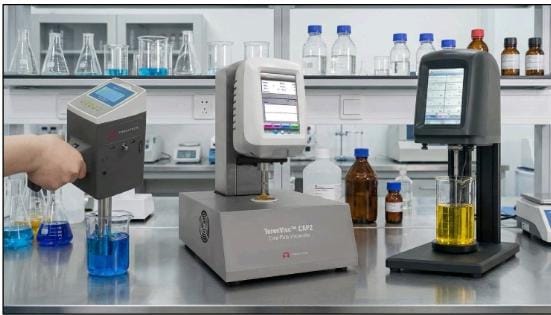
A rotational viscometer is the primary choice for analyzing the complex flow behavior of Non-Newtonian fluids. This instrument works by submerging a spindle into the sample and rotating it at a set speed. The machine measures the torque required to overcome the fluid’s resistance to this movement.
Technicians often refer to this instrument as a rotary viscometer. Its greatest strength lies in its ability to change speeds and spindles. This flexibility allows you to apply different shear rates to the sample.
Building a Flow Curve
You can create a flow curve by measuring viscosity at increasing and decreasing speeds. This graph shows you how a product behaves when sitting on a shelf versus when it is pumped through a high-speed nozzle. This data is necessary for predicting how paints will level out on a wall or how lotion will dispense from a bottle.
Cone and Plate Viscometer: Precision for Small Volumes
Certain applications require a more specialized approach due to high sample costs or limited availability. A cone and plate viscometer utilizes a flat cone rotating against a stationary plate with a microscopic gap between them. You typically need less than one milliliter of fluid to perform a complete test.
This instrument is ideal for biological fluids, expensive pharmaceutical formulations, or specialized resins. The geometry of the cone ensures that the shear rate is uniform across the entire sample volume. This feature allows for the calculation of absolute viscosity with high accuracy.
You also benefit from rapid temperature stabilization due to the small sample size. The thin layer of fluid reaches the target temperature almost instantly compared to a large beaker. This efficiency helps labs that need to run rapid tests at multiple temperatures.
Rheometer vs Viscometer: Which Do You Need?
Buyers frequently struggle to decide between a rheometer vs viscometer for their laboratory. The choice depends on whether you need quality control checks or deep material characterization.
The Viscometer for Quality Control
A viscometer answers the question: “Does this product meet the specification?” It is designed for fast, reliable pass/fail testing in a production environment. You use it to verify that a batch of paint or sauce has the correct consistency before packaging. It focuses primarily on measuring viscosity under simple flow conditions.
The Rheometer for Research and Development
Rheometers provide a deeper look into the material’s internal structure. They measure properties like yield stress, which is the force needed to start flow, and viscoelasticity. Viscoelasticity describes materials that act like both a solid and a liquid, such as memory foam or gelatin.
If you are formulating a new polymer or studying molecular structure, you likely need a rheometer. For routine batch testing and production monitoring, a standard rotational viscometer is usually the more cost-effective and practical choice.
Common Viscosity Measurement Units
Understanding the data output is as important as selecting the machine. Viscometers typically report data in one of two ways.
- Dynamic Viscosity: This is usually measured in Centipoise (cP) or Pascal-seconds (Pa·s). It represents the internal friction of the fluid. Rotational instruments measure this value directly.
- Kinematic Viscosity: This is measured in Centistokes (cSt). It represents the ratio of dynamic viscosity to the fluid’s density. Capillary instruments measure this value.
You must know the density of your sample to convert between these two units accurately. Failing to account for density is a common source of error when comparing data from different instrument types.
Selecting the Right Spindle and Speed
Using a rotational viscometer requires selecting the correct spindle and speed combination. A common rule of thumb is to aim for a torque reading between 10% and 100% of the machine’s range.
- Low Viscosity: Use a large surface area spindle and higher speeds.
- High Viscosity: Use a small surface area spindle and lower speeds.
If your reading is below 10%, the machine is effectively guessing, and the data will be noisy. If the reading hits 100%, the machine is maxed out. Torontech systems often include software that guides you to the optimal settings for your specific sample range.
Final Thoughts
Matching your instrument to your fluid type protects your data integrity and prevents costly manufacturing errors. A simple glass tube works wonders for diesel fuel but fails completely with complex facial creams. Conversely, using a complex rheometer for simple water testing is an unnecessary expense.
You need to assess your specific needs—whether that involves high-throughput kinematic testing or detailed Non-Newtonian flow curves. Understanding the differences between these technologies saves you time, money, and frustration in the long run.
Torontech provides a wide range of testing solutions tailored to every industry and application. Visit the Torontech website today to explore the extensive catalog of viscometers and find the perfect match for your laboratory requirements.