




Fascisterne is Danish for “the fascists.” That’s it. It isn’t the name of a secret society, a band or a forgotten party. It’s an ordinary Danish noun, and you’ll find it in any Danish history book about the 1930s, in newspaper debates and in everyday arguments.
The word has picked up a lot of search traffic lately, and a wave of English-language pages has popped up to explain it. Some of them get basic facts wrong. So this article does two jobs. It explains the word properly, and then it tells the real story of the people Danes have in mind when they say fascisterne: the Danish fascists and Nazis of the 1930s and the German occupation.
What the word means
Danish puts the definite article on the end of the noun instead of in front of it. Here is how the word builds up:
| Danish | English |
|---|---|
| en fascist | a fascist |
| fascisten | the fascist |
| fascister | fascists |
| fascisterne | the fascists |
Norwegian uses the same form, so a Norwegian text can say fascistene or fascisterne depending on the spelling standard. Swedish gets close with fascisterna.
Related words you’ll run into:
- fascisme – fascism, the ideology
- fascistisk – fascist (as an adjective), as in et fascistisk parti
- antifascist / antifascisme – anti-fascist and anti-fascism
- nazisterne – the Nazis, the word Danes use for the German-style movement specifically
Pronunciation is roughly “fa-SHIST-er-neh,” with the stress on the second syllable. The “sc” comes out as a soft “sh” sound, just like in English “fascist.”
Where “fascist” comes from
The word started in Italy, not Denmark. In ancient Rome, officials were escorted by men carrying the fasces, a bundle of rods tied around an axe. It stood for authority and for strength through unity: one stick snaps, a bundle doesn’t. Italian kept the idea in the word fascio, meaning a bundle or a group.
Benito Mussolini founded his Fasci di combattimento, or combat groups, in Milan on 23 March 1919. Most of the early members were war veterans. They were nationalist, against parliamentary democracy and against socialism, and they used street violence to get what they wanted.
The movement took power after the March on Rome in October 1922. From 1925 Mussolini’s party held a monopoly on power and slowly built a dictatorship, even though the king stayed on as formal head of state. The regime also reorganised economic life along “corporatist” lines, putting workers’ and employers’ organisations under the state instead of letting them fight each other.
Once Italy had shown the way, imitators appeared across Europe. Hitler’s Nazis admired Mussolini early on and copied a good deal from him, which is why many historians treat Nazism as a German branch of fascism, with racism and antisemitism pushed to the centre. Denmark got its own imitators too, and that’s where fascisterne becomes a Danish story.
A myth worth clearing up first
If you’ve searched this word in English, you’ve probably seen articles claiming that “Fascisterne” was a Danish party founded in January 1931 by army officer Cay Lembcke, that it ran a paper called Fascisten, and that it fell apart by 1934. That story doesn’t hold up.
Here’s what the record shows. Cay Lembcke was real. He was a cavalry captain (ritmester) in the Guard Hussars and a co-founder of the Danish scouting movement in 1910. He left the scouts in 1923 after years of friction over his fascist leanings. But the party he helped found was the Danmarks Nationalsocialistiske Arbejderparti (DNSAP), the Danish Nazi party, set up on 16 November 1930 right after the Nazis’ big gains in that year’s German election.
No party called simply “Fascisterne” shows up in the standard Danish reference works or in the main histories of Danish Nazism, such as John T. Lauridsen’s Dansk nazisme 1930–45 – og derefter (2002) or Malene Djursaa’s two-volume study of the DNSAP (1981). In Danish, fascisterne is a description, not a brand name. When a Dane writes about “fascisterne” in the 1930s, they mean the whole loose crowd of fascist and Nazi groups, and above all the DNSAP.
Who Denmark’s fascists actually were
Denmark’s far right in the 1930s was small, split into rival groups and full of people who wanted to be the leader. The main players:
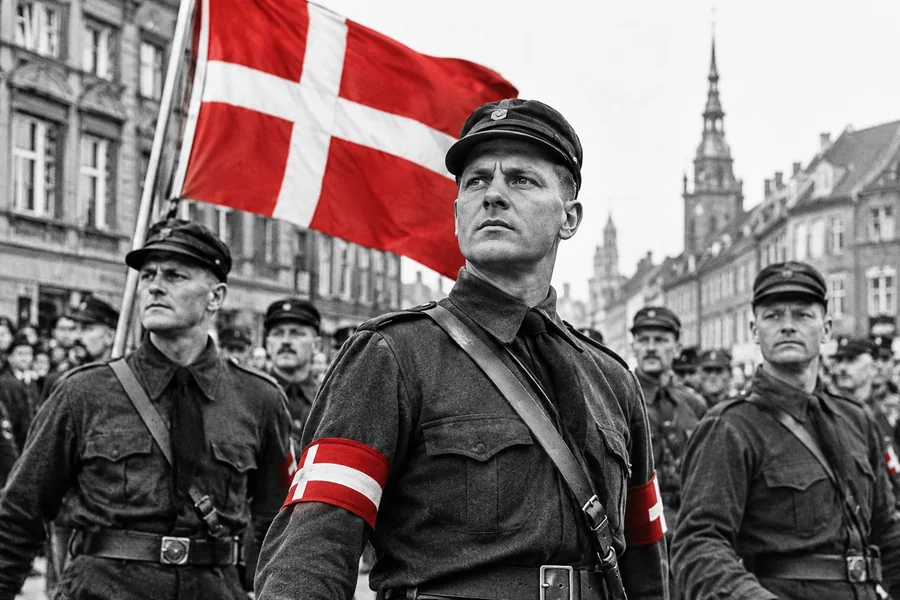
The DNSAP. The Danish Nazi party copied the German original closely: swastika, Hitler salute, a uniformed storm division, a youth wing and a newspaper, Fædrelandet. It also promised loyalty to the Danish king and the national church, which was its way of looking Danish. Under Lembcke it never got beyond a few hundred members. At the November 1932 election it won 757 votes in the whole country.
Frits Clausen. In July 1933 Lembcke was pushed out at a meeting in Aabenraa that historians describe as close to a coup. The new leader was Frits Clausen, a doctor from Southern Jutland. He moved the party’s centre of gravity to the border region, where tension between Danes and the German minority gave him something to work with. Clausen led the party until it was banned in 1945.
Smaller Nazi groups. People like Ejnar Vaaben, possibly the first Danish Nazi of all, kept trying to start their own parties. Vaaben interviewed Hitler for the Danish press as early as September 1930, but none of his ventures found followers, and he drifted between groups.
Conservative admirers of Mussolini. Not every Dane drawn to fascism was a Nazi. Some figures on the Conservative side, Ole Bjørn Kraft among them, praised Mussolini’s Italy in speeches and print. The Conservative Youth (KU) had its own uniformed “storm troops” that marched with raised right arms in 1933.
Dansk Samling. Founded in 1936, this movement was anti-parliamentary and impressed by the new authoritarian states, but it was also Christian and strongly national. Historians often call it semi-fascist. During the occupation it ended up on the side of the resistance, which shows how messy the labels can get.
Why fascism never caught on in Denmark
The Great Depression hit Denmark like everywhere else. Farmers were squeezed, unemployment rose, and in Germany the same pressures helped carry Hitler to power. So why did Danish fascists stay stuck on the fringe? A few things worked against them.
A deal instead of a fight. In January 1933, the same month Hitler became chancellor, Prime Minister Thorvald Stauning’s Social Democrats and the Radical Left struck a broad crisis settlement with the farmers’ party Venstre. It’s known as the Kanslergade Agreement, after Stauning’s flat on Kanslergade where it was hammered out. It didn’t fix everything, but it took the edge off the crisis and showed that parliament could still deliver.
A ban on political uniforms. On 12 April 1933 Denmark passed a law against wearing uniforms for political purposes. It was aimed largely at the uniformed youth corps, including the Conservative Youth storm troops, and it was one of the first laws of its kind in Europe. Sweden pointed to the Danish law when it brought in its own ban a few months later. Further “riot laws” against political violence followed from 1934.
Organised opposition. The left pushed back on the streets. Young Social Democrats formed the Three Arrows movement (Trepilebevægelsen) in 1932 to make anti-fascism visible in Copenhagen. Its best-known member later became Prime Minister: Jens Otto Krag.
A different kind of nationalism. Danish national feeling grew out of N.F.S. Grundtvig’s folkelighed, a tradition built around folk high schools, cooperatives and popular education. Historians often contrast it with the German völkischtradition. Both drew on the idea of “the people,” but in Denmark that idea had mostly fed democratic, progressive movements.
The election results tell the story plainly:
| Folketing election | DNSAP votes | Share | Seats (of 149) |
|---|---|---|---|
| 1932 | 757 | 0.1% | 0 |
| 1935 | 16,257 | 1.0% | 0 |
| 1939 | 31,032 | 1.8% | 3 |
| 1943 | 43,309 | 2.1% | 3 |
Three seats was the high point. The party never came close to real power through the ballot box.
The occupation, 1940–1945
Germany invaded Denmark on 9 April 1940, and the DNSAP welcomed it. Clausen expected the Germans to hand him the government. They didn’t. Berlin preferred to work with the existing Danish government, which kept the country calm and the food exports flowing. The Danish Nazis were useful to the Germans mainly as a threat: a replacement they could point to if the elected politicians stopped cooperating.
Membership did jump. The party had about 5,000 members in 1939 and roughly 21,500 by early 1943. Before the war most members came from the countryside; during the war more came from the towns. Across its whole life, around 39,000 people passed through the party.
The DNSAP’s one real “success” was a grim one. In the summer of 1941, after Germany attacked the Soviet Union, the Danish government allowed the creation of Frikorps Danmark, a volunteer unit that fought on the Eastern Front as part of the Waffen-SS. The party played a big part in recruiting for it and for other SS units. Party propaganda sold the volunteers as modern Vikings defending the North against Bolshevism.
The March 1943 election was the turning point. Turnout was very high, and Danes used it to show support for the democratic parties. The DNSAP won more votes than in 1939 but still only three seats. After that flop the party began to come apart.
When the occupation ended in May 1945, the DNSAP was banned on 8 May. Members and collaborators were then caught up in the post-war legal reckoning, the retsopgør. Frits Clausen was arrested and died in prison in December 1947 before his case came to trial.
After the war and in Danish today
The movement never fully died. A small neo-Nazi scene kept going, and after several splits and renamings it settled in 1991 as the Danmarks Nationalsocialistiske Bevægelse (DNSB), founded by Jonni Hansen. It openly claims descent from the DNSAP. It has stayed tiny and has no seats anywhere.
The word fascisterne has had a longer life than the parties. In post-war Denmark it became shorthand for the anti-democratic side of the 1930s and the occupation: the people who marched in uniforms, cheered the invasion and recruited for the SS. You’ll meet it in school textbooks, museum exhibitions, novels and films about the occupation, and in political arguments.
That last use is where it gets heated. Danish commentators, like people everywhere, regularly ask whether modern leaders such as Donald Trump, Vladimir Putin, Viktor Orbán or Giorgia Meloni deserve the label. Scholars disagree. Some say several core features of fascism are clearly present; others say the word loses its meaning if it’s stretched beyond the interwar movements and their direct heirs. Both the Danish and Norwegian national encyclopedias note that this modern use is disputed rather than settled.
So when you read fascisterne in a Danish text, check the date. In a history book it almost always means the real fascists and Nazis of 1919–1945. In a newspaper comment section, it may just mean “people I think are dangerous.”
Using the word in a sentence
A few examples of how fascisterne turns up in normal Danish:
- Fascisterne kom til magten i Italien i 1922. – The fascists came to power in Italy in 1922.
- Mange danskere så med mistro på fascisterne. – Many Danes looked at the fascists with suspicion.
- Bogen handler om fascisterne i mellemkrigstiden. – The book is about the fascists in the interwar years.
- Modstandsfolkene kæmpede mod nazisterne og fascisterne. – The resistance fought the Nazis and the fascists.
Two small tips if you’re writing in Danish. First, the word isn’t capitalised unless it starts a sentence, because it’s a common noun. Second, Danes usually keep fascisterne (Mussolini-style) and nazisterne (Hitler-style) apart when talking about history, even though the Danish Nazis are often lumped in with “the fascists” in everyday speech.
FAQ
What does “fascisterne” mean in English? It means “the fascists.” It’s the plural, definite form of the Danish word fascist.
Was there a Danish party called Fascisterne? Not under that name. The main Danish Nazi party was the DNSAP, founded on 16 November 1930. Fascisterne is the general Danish term for fascists, not a party title.
Who was Cay Lembcke? A Danish cavalry captain, scouting pioneer and the first leader of the DNSAP. He led it from 1930 until he was replaced by Frits Clausen in July 1933.
How popular were the fascists in Denmark? Not very. The Nazi party’s best result was 2.1% of the vote in 1943, which gave it three seats out of 149.
Is the word still used today? Yes. Mostly in history writing, but also in politics, where calling someone a fascist is a serious and often disputed charge.
Is it Danish or Norwegian? It’s standard Danish. Older Norwegian spelling used the same form, while modern Norwegian Bokmål usually writes fascistene.
Sources
- Fascisme – Lex.dk (Den Store Danske)
- Danmarks Nationalsocialistiske Arbejderparti – Lex.dk
- Folketingsvalget 1939 – Lex.dk
- Folketingsvalget 1943 – Lex.dk
- Urolovene, 1934–1952 – Lex.dk
- Trepilebevægelsen – Lex.dk
- Cay Lembcke – Wikipedia
- National Socialist Workers’ Party of Denmark – Wikipedia
- Kristina Krake, “Militant demokrati” – Arbejderhistorie
- Frits Clausen og »førerkuppet« i DNSAP – Sønderjyske Årbøger
- Hvad er fascisme? – Videnskab.dk
- Fascisme – Store norske leksikon