









From industrial equipment and laboratory assemblies to building systems and custom machinery, Central Massachusetts companies often need parts that balance accuracy, durability, and realistic lead times. A small machined housing, a high-volume sheet metal bracket, and a load-bearing shaft may use similar alloys, yet each may call for a very different manufacturing route. For businesses comparing Forged Metal Components Shrewsbury, MA, S.O. Sales provides a Shrewsbury-based manufacturing resource with capabilities that include castings, forgings, precision CNC machining, stamping and forming, electro-mechanical products, finishing, assembly, and testing. Its broad component focus makes it a useful regional contact for manufacturers in Central Massachusetts that need to evaluate drawings, specifications, production quantities, and secondary operations as one connected project.
Why Process Selection Matters
The manufacturing method affects more than the initial quote. It can influence material use, tooling investment, achievable features, mechanical performance, inspection needs, surface appearance, and the time required to move from prototype to production. Selecting a familiar process before defining the part can produce unnecessary scrap, hard-to-control features, or costs that become apparent only after production begins.
Start With the Part, Not the Machine
Before requesting quotes, document the requirements that actually determine how the part should be made:
- Function: What does the component support, seal, connect, protect, or move?
- Material: Which alloy, polymer, or other material is required, and why?
- Quantity: How many prototypes, pilot parts, annual units, and lifetime units are expected?
- Critical dimensions: Which features control fit, motion, sealing, alignment, or safety?
- Finish: Does the part need deburring, plating, coating, heat treatment, polishing, or marking?
A process should follow these requirements. Choosing equipment first can force a design into an inefficient route, rather than allowing the part and production plan to determine the best route.
Match the Process to Part Geometry
Part shape quickly narrows the practical options. Machining removes material from a larger workpiece and can be applied to blocks, plates, shafts, threaded features, and detailed surfaces. It is commonly considered when a part needs controlled dimensions or when quantities do not justify dedicated hard tooling.
- Simple blocks, shafts, and plates: CNC turning or milling may provide strong dimensional control.
- Thin brackets, guards, trays, and enclosures: Sheet metal cutting and forming can efficiently create bent features.
- Complex cavities or contoured forms: Casting can create near-net shapes that need less later material removal.
- High-load structural forms: Forging may be considered for shafts, fittings, fasteners, and similar components.
- Internal channels or highly customized shapes: Additive manufacturing may be useful for early-stage or specialized applications.
Compare the Main Manufacturing Options
CNC Machining
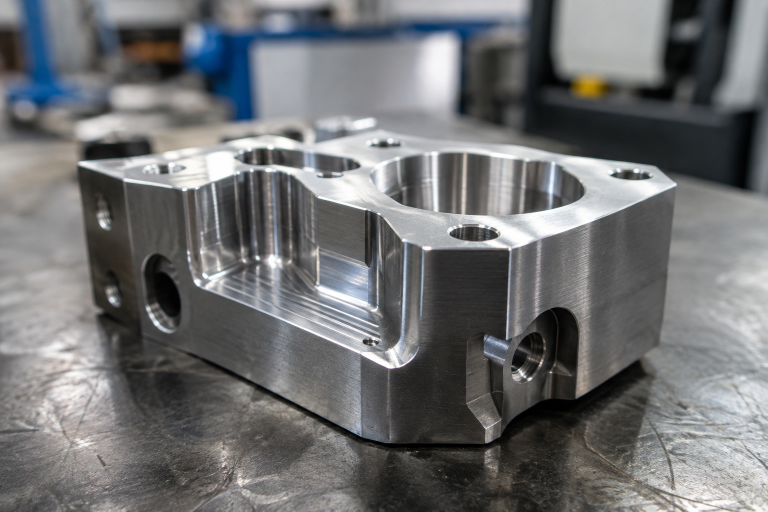
CNC machining can produce precise holes, threads, faces, profiles, and turned diameters from bar, plate, billet, or other stock. It offers design flexibility and can support prototypes through recurring production. Its trade-offs include material removed as chips, the possibility of multiple setups, and rising piece costs when quantities are high enough for dedicated tooling to be economical.
Forging and Casting
Forging shapes metal under controlled force, and it can be appropriate for parts where material properties and structural performance are important. Casting can form complex shapes with less subsequent removal than machining from solid stock. Both routes require early review of geometry, tooling, draft, shrinkage, machining allowances, inspection, and expected volume.
Sheet Metal Fabrication and Additive Manufacturing
Cutting, punching, bending, and forming are practical for many thin-walled components. Good designs account for material thickness, bend radius, bend allowance, and springback. Meanwhile, additive manufacturing builds parts layer by layer, making it useful for prototypes, low-volume custom work, lightweight forms, and features that are difficult to access with cutting tools. Additive parts may still require machining, finishing, or other post-processing.
Use Production Volume to Guide the Decision
Volume changes the cost equation. For one-off parts and small prototype quantities, flexible processes without dedicated tooling may be preferable. For small batches, CNC machining, forming, or rapid tooling can offer a workable balance. As demand becomes more stable and quantities rise, casting, forging, molding, stamping, or specialized forming may become more attractive because upfront tooling can be spread across more units.
Compare the complete project cost, not just the part price. Include setup, tooling, inspection, finishing, packaging, freight, scrap, and the likelihood of design changes.
Set Realistic Tolerances and Finish Requirements
Not every feature needs the tightest possible tolerance. Tight requirements can add machining time, specialized inspection, extra setups, and the risk of rejection. Divide drawing requirements into critical features that affect fit or safety, functional features that support normal operation, and non-critical features that can use standard tolerances. Finish requirements deserve the same attention. Specify only the surface finish, deburring level, coating, plating, heat treatment, or cosmetic standard that the part truly needs. An unclear requirement can lead to inconsistent assumptions among suppliers.
Consider Materials and Hybrid Routes
Material selection and process selection should be reviewed together. Strength, hardness, corrosion resistance, temperature exposure, weight, conductivity, machinability, and availability can all affect the route. A material may meet performance requirements but be difficult to form, machine, weld, or finish economically. Hybrid manufacturing is often practical. A part might be cast or forged near its final form, then machined on sealing surfaces and threaded holes. A stamped component may receive coating and assembly. A printed prototype can validate fit before a production version moves to molding or forming.
Prepare a Better Request for Quote
Send suppliers a current 3D CAD file, a fully dimensioned 2D drawing, material grade and condition, initial and annual quantity, critical tolerances, inspection needs, required finish, delivery target, and any packaging or labeling instructions. Complete information lets suppliers quote the same scope and identify process concerns early.
How to Evaluate a Manufacturing Partner
Ask whether the supplier has made comparable parts, can support the required materials and tolerances, and has appropriate inspection equipment. Also ask how design revisions are controlled, whether finishing is managed in-house or through qualified partners, what occurs if a first article does not meet requirements, and whether the supplier can support both prototypes and later production.
Common Mistakes and a Simple Decision Framework
Frequent mistakes include selecting a process before defining the part, applying tight tolerances everywhere, overlooking tooling and finishing, and assuming the fastest prototype route will be best for production. Avoid these issues by following these five steps:
- Define the function, material, size, and major features.
- Separate prototype, pilot, annual, and lifetime quantities.
- Identify critical tolerance, finish, strength, and inspection requirements.
- Compare process routes, including tooling, waste, lead time, and secondary operations.
- Confirm total cost, including future design changes and logistics.
Frequently Asked Questions
Which process is best for tight tolerances?
CNC machining is often considered when dimensional control is a primary concern, although material, feature size, geometry, inspection method, and production volume still matter.
Is forging always stronger than machining?
Not necessarily. Final performance depends on alloy selection, part geometry, heat treatment, processing, and the conditions the finished part will experience.
When does dedicated tooling make sense?
Tooling is easier to justify when the design is stable, and expected quantities can spread the upfront investment across enough parts.
Can one part use multiple processes?
Yes. Many production parts combine a primary process with machining, heat treatment, coating, assembly, and inspection.
Conclusion
The right process begins with the part’s actual requirements, not a preferred machine or a low initial piece price. Shrewsbury-area buyers who clearly define geometry, material, quantity, tolerance, finish, and delivery expectations can compare manufacturing routes more fairly, reduce avoidable revisions, and build a production plan that supports both immediate needs and future growth. It is also useful to consider the part’s expected service conditions, inspection requirements, packaging needs, and whether the design may change as production volumes increase. Asking suppliers to explain their recommended process, tooling requirements, setup costs, lead times, and quality controls can make the differences between manufacturing options easier to understand. A clear set of requirements also gives suppliers a consistent basis for quoting and helps engineering and purchasing teams communicate more effectively throughout the project. By defining these details early, buyers can make more informed decisions and establish a manufacturing approach that remains practical as requirements evolve.